
She Had No Symptoms. That’s Exactly Why It Was Dangerous.
She was 38. Busy mother of two. No pain, no unusual bleeding, no warning signs. She came to me not because something felt wrong — but because her sister had just been diagnosed with cervical cancer and, finally, that fear pushed her to get checked.
Her screening came back with early abnormal changes. We caught it before it became cancer. She’s perfectly fine today.
The women I worry about most are not the ones in my clinic. They’re the ones who haven’t come yet — because they feel fine, because nobody told them to, because life got in the way.
Cervical cancer is one of the few cancers we can genuinely prevent and detect early. Yet in India, most women are diagnosed at an advanced stage — not because medicine failed them, but because screening never reached them.
This article is for every woman who has never had a Pap smear. Every caregiver who didn’t know there was a test to ask for. Every daughter who wants to protect her mother.
Let’s fix that gap, right now, together.
What is Cervical Cancer?
The cervix is the lower part of the uterus — the narrow passage that connects the womb to the vagina. Cervical cancer occurs when the cells lining this passage begin to grow abnormally and, over time, turn malignant.
Here’s the important part: this doesn’t happen overnight.
In almost all cases, cervical cancer begins as a slow, gradual process triggered by a persistent infection with certain high-risk strains of Human Papillomavirus — HPV. The virus quietly alters the DNA of cervical cells. Years pass. Slowly, pre-cancerous changes develop. And only then, if left undetected and untreated, does it become cancer.
That long, slow progression is actually our greatest advantage. It gives us a wide window to detect it early — and stop it in its tracks.
Why Screening is So Critical in India
India accounts for nearly one-fifth of all cervical cancer deaths worldwide. Every year, over 1.25 lakh Indian women are diagnosed — and roughly 75,000 lose their lives to a cancer that, caught early, has a cure rate above 90%.
Why such a heavy burden? Several overlapping reasons:
- Low screening rates. Studies suggest fewer than 3% of Indian women aged 30–49 have ever undergone cervical screening.
- Late presentation. Most women in India are diagnosed at Stage 3 or Stage 4, when the cancer has already spread significantly.
- Awareness gaps. Many women — and many families — don’t know these tests exist, or believe symptoms must appear first.
- Cultural hesitancy. Discussions around reproductive health remain uncomfortable in many households.
The tragedy is that this is not a cancer without answers. We have the tools. We just need to use them.
What is a Pap Smear?
A Pap smear — also called a Pap test or cervical cytology — is a simple, quick screening test that looks for abnormal cells in the cervix before they have a chance to become cancer.
How is it done?
You lie on an examination table, and a doctor or nurse gently inserts a speculum — a small medical instrument — to see the cervix clearly. Using a soft brush or spatula, they collect a small sample of cells from the cervix. The sample is sent to a lab where it’s examined under a microscope.
The whole process takes about 5 minutes. It causes mild discomfort — like a light pressure — not pain. Think of it as a brief moment of awkwardness in exchange for years of peace of mind.
What does it detect?
A Pap smear detects abnormal cell changes — called dysplasia — that may indicate pre-cancer or early cancer. It does NOT directly test for HPV.
How often should you get one?
- Every 3 years from age 21 onwards if results are normal
- Or every 5 years if combined with an HPV test (co-testing)
What is HPV Testing?
An HPV test goes one step deeper. Rather than looking at the cells themselves, it looks for the presence of high-risk HPV DNA in the cervical sample.
Think of the Pap smear as checking whether a fire has started. The HPV test checks whether someone left a lit match lying around.
Why does this matter?
Because HPV infection precedes cervical cancer — sometimes by 10 to 15 years. Detecting the virus early allows us to monitor and intervene before any cellular damage even begins.
Is it more accurate?
Yes. The HPV test has higher sensitivity than the Pap smear alone — meaning it catches more true cases and misses fewer. This is why international guidelines increasingly recommend HPV-primary screening.
When is it recommended?
- From age 30 onwards, either alone or in combination with a Pap smear (called co-testing)
- Women aged 25–29 may receive HPV testing if their Pap smear is abnormal
Pap Smear vs HPV Test — What’s the Difference?
| Feature | Pap Smear | HPV Test |
|---|---|---|
| What it tests | Abnormal cells | HPV virus DNA |
| Age to start | 21 years | 25–30 years |
| Frequency | Every 3 years | Every 5 years |
| Sensitivity | Moderate | High |
| Detects cancer early? | Yes | Yes (even earlier) |
| Best used | Alone or with HPV test | Alone or with Pap smear |
| Availability in India | Widely available | Growing availability |
The gold standard today, for women 30 and above, is co-testing — doing both together. This combination gives the highest level of reassurance.
Who Should Get Screened?
Age 21–29: Pap smear every 3 years. HPV testing only if Pap result is abnormal.
Age 30–65: Co-testing (Pap + HPV) every 5 years. Or Pap smear alone every 3 years. Or HPV test alone every 5 years.
After 65: Screening can stop if you’ve had consistently normal results in the past 10 years. Discuss with your doctor.
Special situations to note:
- If you are sexually active, screening is relevant regardless of marital status
- If you are post-menopausal, don’t assume you no longer need screening — HPV doesn’t retire just because your periods do
- If you have a history of abnormal Pap smears, HIV, or are immunocompromised, your doctor may recommend more frequent screening
- If you’ve had a hysterectomy (complete removal of uterus and cervix), routine Pap smears may not be needed — confirm with your doctor
Common Myths That Are Costing Lives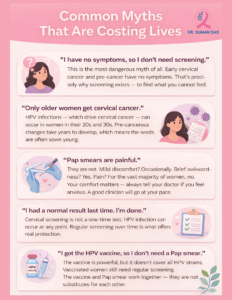
“I have no symptoms, so I don’t need screening.”
This is the most dangerous myth of all. Early cervical cancer and pre-cancer have no symptoms. That’s precisely why screening exists — to find what you cannot feel.
“Only older women get cervical cancer.”
HPV infections — which drive cervical cancer — can occur in women in their 20s and 30s. Pre-cancerous changes take years to develop, which means the seeds are often sown young.
“Pap smears are painful.”
They are not. Mild discomfort? Occasionally. Brief awkwardness? Yes. Pain? For the vast majority of women, no. Your comfort matters — always tell your doctor if you feel anxious. A good clinician will go at your pace.
“I had a normal result last time. I’m done.”
Cervical screening is not a one-time test. HPV infection can occur at any point. Regular screening over time is what offers real protection.
“I got the HPV vaccine, so I don’t need a Pap smear.”
The vaccine is powerful, but it doesn’t cover all HPV strains. Vaccinated women still need regular screening. The vaccine and Pap smear work together — they are not substitutes for each other.
What Happens if My Test is Abnormal?
Take a breath. An abnormal result does not mean you have cancer.
Most abnormal Pap smear results indicate mild cellular changes — called ASCUS or low-grade dysplasia — that the body often resolves on its own. Your doctor will recommend a repeat test, or a closer look using a procedure called colposcopy, where the cervix is examined under magnification.
If pre-cancerous changes are confirmed, there are simple, highly effective treatments available — LEEP (Loop Electrosurgical Excision Procedure), cryotherapy, or cone biopsy — that remove the affected tissue before it progresses.
The message here is this: an abnormal result is a head start, not a death sentence. It is medicine working exactly as it should — catching things early, when they are still very treatable.
*[Internal link: “What Happens After an Abnormal Pap Smear — A Step-by-Step Guide”]
Cost and Availability in India
Pap smear: ₹300 – ₹800 at most hospitals and diagnostic centres. Available widely in urban and semi-urban areas.
HPV test: ₹1,500 – ₹3,000. Availability growing, especially in metropolitan cities and larger towns.
Co-testing (Pap + HPV): ₹2,000 – ₹4,000 combined.
Free and subsidised options:
- Government hospitals and Primary Health Centres (PHCs) often offer free Pap smears under the National Cancer Screening Programme
- Rashtriya Bal Swasthya Karyakram (RBSK) and several state government schemes include cervical cancer screening
- NGOs like the Cancer Patients Aid Association (CPAA) and Cachar Cancer Hospital offer low-cost or free screening camps periodicallyhttps://www.pib.gov.in/PressReleasePage.aspx?PRID=2233632®=3&lang=1
If cost is a barrier, ask at your nearest government hospital or district health office. You may be surprised by what’s available at no charge.
Prevention Beyond Screening
Screening catches cancer early. But we can go further upstream.
HPV vaccination is the most powerful preventive tool we have. Given ideally between ages 9 and 14 — before any exposure to HPV — it dramatically reduces the risk of developing the high-risk strains that cause most cervical cancers. Even up to age 45, vaccination can offer meaningful protection.
Lifestyle factors also matter:
- Avoid smoking — it weakens local cervical immunity and increases HPV persistence
- Maintain good nutritional health — a strong immune system clears HPV more efficiently
- Attend regular gynaecological check-ups — your annual visit is never just a formality
Screening and vaccination together are not redundant. They are complementary pillars of protection.
*[Internal link: “HPV Vaccine in India — Cost, Age Limit, Doses, and Side Effects Explained”]
A Simple Test Today Can Save Your Life Tomorrow
I want to close this the same way I open every conversation with my patients about prevention: with honesty and with hope.
Cervical cancer does not have to be a death sentence. It doesn’t even have to be a diagnosis. If we use the tools available to us — screening, vaccination, awareness — we can stop it before it starts, or catch it so early that full cure is entirely possible.
You owe yourself that.
Book the test. Make the appointment. Tell your mother, your sister, your friend. The 15 minutes of a Pap smear appointment is one of the most meaningful investments a woman can make in her own future.
Frequently Asked Questions (FAQ)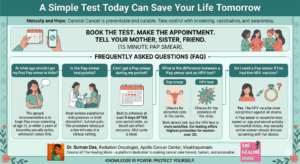
Q: At what age should I get my first Pap smear in India? The general recommendation is to begin Pap smear screening at age 21, or within 3 years of becoming sexually active, whichever comes first.
Q: Is the Pap smear test painful? Most women experience mild pressure or brief discomfort, but not pain. The procedure takes just a few minutes and is performed by a doctor or trained nurse in a clinical setting.
Q: Can I get a Pap smear during my period? It’s best to schedule your Pap smear at least 5 days after your period ends, as menstrual blood can affect the accuracy of the sample. Mid-cycle is ideal.
Q: What is the difference between a Pap smear and an HPV test? A Pap smear checks for abnormal cells in the cervix. An HPV test checks for the presence of the virus itself. Both detect risk for cervical cancer, but the HPV test is more sensitive. Co-testing — doing both together — offers the highest level of protection for women over 30.
Q: Do I need a Pap smear if I’ve had the HPV vaccine? Yes. The HPV vaccine does not protect against all strains of HPV. Vaccinated women should continue to follow standard cervical cancer screening guidelines.
Q: Can unmarried women get a Pap smear? A Pap smear is recommended based on age and sexual activity — not marital status. Any woman who is or has been sexually active can and should discuss screening with her doctor.
Dr. Suman Das is a Radiation Oncologist at Apollo Cancer Center, Visakhapatnam, and creator of The Healing Monk — a platform dedicated to making cancer care honest, human, and accessible.
For more evidence-based health content, subscribe at drsumandas.com or follow The Healing Monk on YouTube.


