
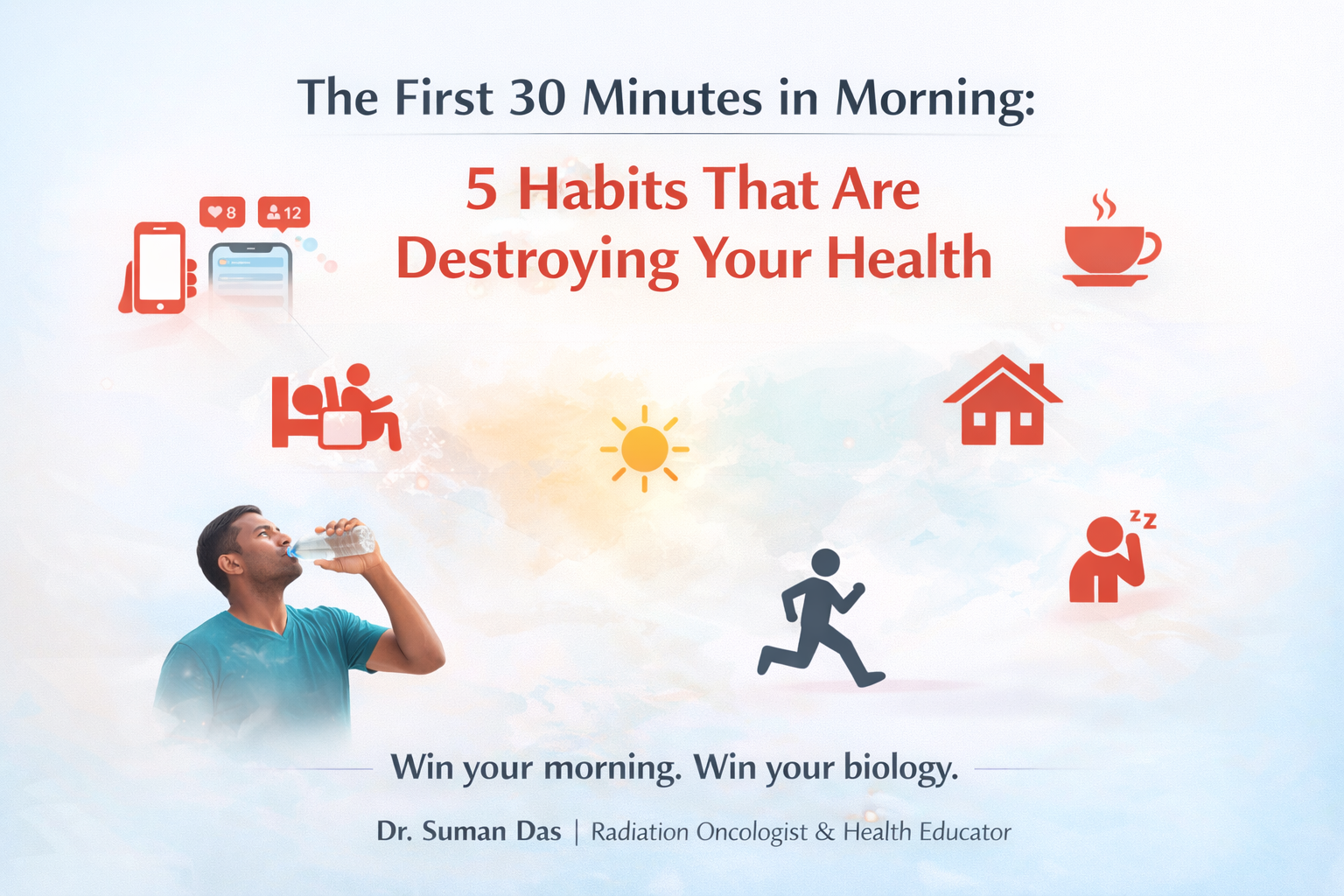
The Morning Habit: The Alarm Goes Off And Then It All Goes Wrong….
It’s 6:30 AM.
You reach for your phone before your eyes are fully open. You scroll through WhatsApp messages, check yesterday’s Instagram likes, maybe panic-read a few news headlines. Somewhere between reels and notifications, twenty minutes disappear. You finally drag yourself upright, skip to the bathroom, pour a strong cup of tea — because without it, you’re basically a zombie — and sit back down. No sunlight. No movement. No water. Just you, your phone, and the quiet unraveling of what could have been your most powerful biological window of the day.
Sound familiar? I’ve been there. Most of us have.
Here’s what medicine — and my years running before dawn and working with cancer patients who desperately want their health back — has taught me: “The first 30 minutes after waking are not ordinary time.” They are a biological launchpad. And most of us are sabotaging them before the day even begins.
Let’s fix that.
Why Your First 30 Minutes Matter More Than You Think
Your body doesn’t wake up randomly. It follows an exquisitely precise internal clock your “circadian rhythm” orchestrated by a cluster of neurons in the brain called the suprachiasmatic nucleus (SCN)
This clock governs everything: Hormone release, Metabolism, Immune function, Mood and Cognition.
Every morning, your body executes something called the “Cortisol Awakening Response (CAR)” a sharp, natural spike in cortisol (yes, the “stress hormone,” but also your body’s built in alarm system and energy mobilizer) that peaks 30–45 minutes after waking.
This spike is supposed to be there. It sharpens focus, prepares your immune system, regulates blood sugar, and gets your brain online.
The problem?
The morning habits most of us have adopted in those first 30 minutes actively interfere with this process blunting the CAR, disrupting dopamine, flooding the amygdala and setting a neurological tone for the rest of the day that we spend hours trying to recover from.
The good news:
small, intentional changes in this window have outsized effects. Your morning habit isn’t just about productivity. It’s about biology.
Let’s go through the five biggest offenders.
Morning Habit 1: Reaching for Your Phone First Thing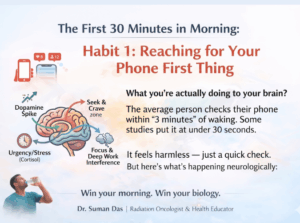
What you’re actually doing to your brain?
The average person checks their phone within “3 minutes” of waking. Some studies put it at under 30 seconds. It feels harmless — just a quick check. But here’s what’s happening neurologically:
Your brain’s prefrontal cortex (responsible for calm, rational thinking) is still warming up when you wake.
Your amygdala (the emotional alarm system) is disproportionately active in the early minutes.
When you immediately flood this system with news, notifications, and social media each designed by engineers to trigger a dopamine micro hit , you’re not starting your day. You’re hijacking it.
Dopamine dysregulation: Social media exploits your reward circuitry. Every notification is a small dopamine ping. Start your morning with 20 minutes of rapid-fire pings, and you raise the dopamine baseline artificially, making ordinary life feel flat and unstimulating by comparison. This is the neurological architecture of anxiety and low motivation.
Cortisol misfiring: Stressful news or a work email read first thing doesn’t just make you anxious. It activates your HPA axis (hypothalamic-pituitary-adrenal axis) and distorts your cortisol awakening response, turning your biological energizer into a stress reactor.
Attention fragmentation: Researchers at the University of California, Irvine found it takes an average of 23 minutes to regain deep focus after a digital interruption. You’re fragmenting your attention before you’ve even had a chance to focus once.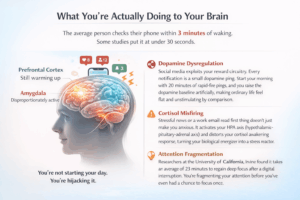
What to do instead
Keep your phone outside the bedroom or at minimum, across the room.
Use a physical alarm clock. They still exist. They’re excellent.
Create a “phone-free first 20 minutes”rule. Give your cortisol response the space to do its job before the internet shows up.
If you must check something urgent, do it standing up, after water and sunlight. Context matters.
Morning Habit 2: Sitting Still Instead of Moving
The optical flow effect no one talks about
Most of us roll out of bed and immediately settle into another seated position — the sofa, the dining chair, hunched over a cup of tea.
But movement (even gentle walking) triggers something profound in the nervous system called optical flow.
Optical flow is what happens when your visual field moves relative to your body like when you walk through a space and objects stream past your peripheral vision. Neuroscientist Andrew Huberman has popularized this concept: optical flow suppresses the activity of the amygdala.
In plain language, walking — even a slow, aimless 10-minute walk, neurologically calms anxiety and activates the brain’s executive network.
Amygdala activation: Waking up and staying still while ruminating (or scrolling) keeps the amygdala in a heightened state. Movement physiologically dials this down.
Brain activation: Physical movement increases cerebral blood flow. The brain gets more oxygen. Neurons fire more efficiently. Fog lifts.
Postural tone and metabolism: Prolonged morning sitting slows lymphatic drainage, stiffens the spine, and blunts your morning metabolic spike. Your body literally thinks it’s still in rest mode.
What to do instead?
Within the first 10–15 minutes of waking, get vertical and walk. Even indoors. Even in circles.
Walk to a window and look outside you’ll stack the benefits of movement with sunlight exposure (more on that next).
If you’re a runner or cyclist (and if you’re reading this blog, you might be), know that a morning movement practice however brief sets a neurological and hormonal tone that genuinely lasts for hours.
Morning Habit 3: Tea or Coffee Before Hydration
The dehydration trap hiding in your favourite mug
I’m not going to tell you to give up your morning chai. That would be cruel and also career-ending in India. But the timing matters enormously.
Here’s the physiology: you have been fasting and breathing for 7–8 hours. Your body loses roughly 500ml to 1 litre of water overnight through respiration, transpiration, and cellular processes. You wake up mildly dehydrated every single morning. This is normal. But what you do next determines whether you fix it or compound it.
Caffeine is a diuretic. It inhibits vasopressin (an antidiuretic hormone) and increases urine output. Drinking coffee or tea on an already dehydrated system as your very first act does not hydrate you it nudges dehydration further, right at the moment your body is trying to reactivate every system.
Additionally:
Cortisol and caffeine overlap: Your natural cortisol awakening response peaks between 30–45 minutes after waking. Caffeine works partly by blocking adenosine receptors (adenosine is the “tiredness signal”). When cortisol is already doing that job naturally, adding caffeine on top creates redundancy — and potentially increases your caffeine tolerance and dependency. The better window for caffeine is actually 90–120 minutes after waking, once your natural cortisol spike has tapered.
Blood sugar and dehydration: Mild dehydration impairs concentration, increases perceived exertion, and affects mood. Starting your brain’s most critical window in a dehydrated state is like asking a car to perform on an empty tank.
What to do instead 
Before anything else: drink 500ml–750ml of water. Room temperature or warm. A squeeze of lemon is optional but pleasant.
Wait 30–60 minutes before the first cup of tea or coffee.
Electrolytes (a pinch of pink salt, coconut water) can be useful if you’re a heavy sweater or morning exerciser.
Your chai will taste better when your body is ready for it. Trust me on this one.
Morning Habit 4: Avoiding Sunlight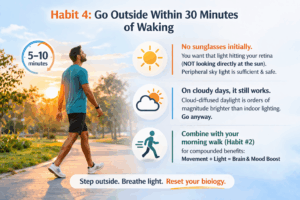
The silent circadian disruptor
This is the one most people underestimate and arguably the one with the most far reaching consequences.
Your circadian rhythm is anchored by light. Specifically, it needs bright natural light preferably sunlight entering through your eyes within the first 30–60 minutes of waking. This signal travels from the retina to the suprachiasmatic nucleus, which then fires a cascade of signals that:
Suppresses melatonin — telling your brain the sleep phase is over and initiating the active phase
Sets your cortisol rhythm— amplifying and correctly timing your CAR
Programs your “sleep pressure timer” so that roughly 14–16 hours later, melatonin rises again naturally and you feel genuinely sleepy at the right time
Without morning light exposure, this cascade is blunted or delayed. The downstream effects are not subtle:
Disrupted sleep: If your circadian clock isn’t properly anchored in the morning, your melatonin rise in the evening is delayed making it harder to fall asleep, reducing sleep quality, and shortening deep sleep.
Mood dysregulation: Light is a direct input into serotonin synthesis. Morning light increases serotonin availability. Chronically skipping it is associated with low mood, seasonal affective disorder, and fatigue.
Metabolic consequences:Circadian misalignment ,when your internal clock is out of sync is associated with increased inflammation, impaired glucose metabolism, and over time, higher cancer risk. (Yes, this is something I see from the oncology side. Night-shift workers and people with chronically disrupted circadian rhythms have measurably higher rates of certain cancers. Mornings matter.)https://drsumandas.com/miles-of-healing-balancing-oncology-running-and-life/
What to do instead
Go outside within the first 30 minutes of waking — even for 5–10 minutes. No sunglasses initially. You want that light hitting your retina (NOT looking directly at the sun — peripheral sky light is sufficient and safe).
On cloudy days, it still works cloud diffused daylight is orders of magnitude brighter than indoor lighting. Go anyway.
Combine this with your morning walk (habit #2) for compounded benefit.
Morning Habit 5: Skipping Exercise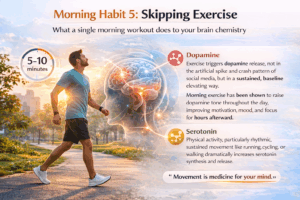
What a single morning workout does to your brain chemistry
This one is personal for me. I’m a runner. I’ve run before 5 AM with the stars still out and the city still asleep. And I can tell you — the version of me that runs in the morning and the version that doesn’t are genuinely different people.
Here’s why that’s not just metaphor:
Dopamine: Exercise triggers dopamine release, not in the artificial spike and crash pattern of social media, but in a sustained, baseline elevating way.
Morning exercise has been shown to raise dopamine tone throughout the day, improving motivation, mood, and focus for hours afterward.
Serotonin: Physical activity, particularly rhythmic, sustained movement like running, cycling, or walking dramatically increases serotonin synthesis and release. This is literally the same neurotransmitter that antidepressants work on. Exercise is antidepressant pharmacology without the pharmacy.
BDNF (Brain-Derived Neurotrophic Factor): Often called “fertilizer for the brain,” BDNF is released in significant quantities during aerobic exercise. It promotes neuroplasticity, protects existing neurons, and enhances learning and memory.
Morning exercise doesn’t just energize you — it structurally improves your brain’s capacity to function.
Cortisol regulation: Exercise in the morning works with your cortisol awakening response both are in their natural peak window. This synergy leads to proper cortisol clearance by afternoon, reduced baseline anxiety, better sleep, and improved immune function. People who exercise regularly in the morning have more normalized diurnal cortisol patterns a biomarker of resilience and health.
Insulin sensitivity: Morning exercise significantly improves glucose uptake and insulin sensitivity for the rest of the day — critical for metabolic health, weight management, and cancer risk reduction.
What to do instead
You do not need 90 minutes, even 20–30 minutes of moderate aerobic movement (brisk walk, jog, cycle, yoga flow) is sufficient to trigger the neurotransmitter and hormonal cascade.
If you’re new to this: start with a 15-minute walk. That’s it. That is enough to begin changing your neurochemistry.
Stack it with sunlight exposure, exercise outdoors in morning light and you hit two habits simultaneously.
Resistance training works too. The BDNF and dopamine benefits apply to strength work as well.
The Summary: Your New First 30 Minutes
Let me make this simple. Here’s what the science — and honestly, what lived experience as both a clinician and an athlete 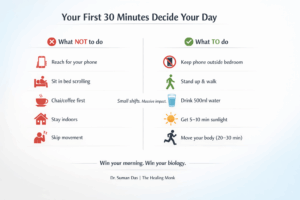
You don’t need all five perfectly from day one. Pick one. Do it for a week. Notice how you feel.
Because here’s the thing I want you to take away: your body is not trying to make your life difficult.
It has an extraordinary system, calibrated by millions of years of evolution designed to help you wake up well, feel energized, think clearly, and move through the world with resilience. The habits we’ve accidentally built around our mornings are working against that system, not with it.
Your morning routine is not about discipline. It’s about alignment. Get aligned with your biology, and the rest of the day — the focus, the energy, the mood — tends to follow.
The alarm went off. Now let’s not waste the window.
Dr. Suman Das is a Radiation Oncologist at Apollo Cancer Center, Visakhapatnam, and the creator of The Healing Monk — a health education platform on YouTube and podcast. https://drsumandas.com/sacred-strides-marathon-across-the-divine-lanes-of-holy-city-puri/He writes about cancer, lifestyle medicine, and the science of feeling well.https://drsumandas.com/self-improvement-goals2025
For more content on health, healing, and running through life, follow The Healing Monk on YouTube. https://www.youtube.com/@thehealingmonk2754


