
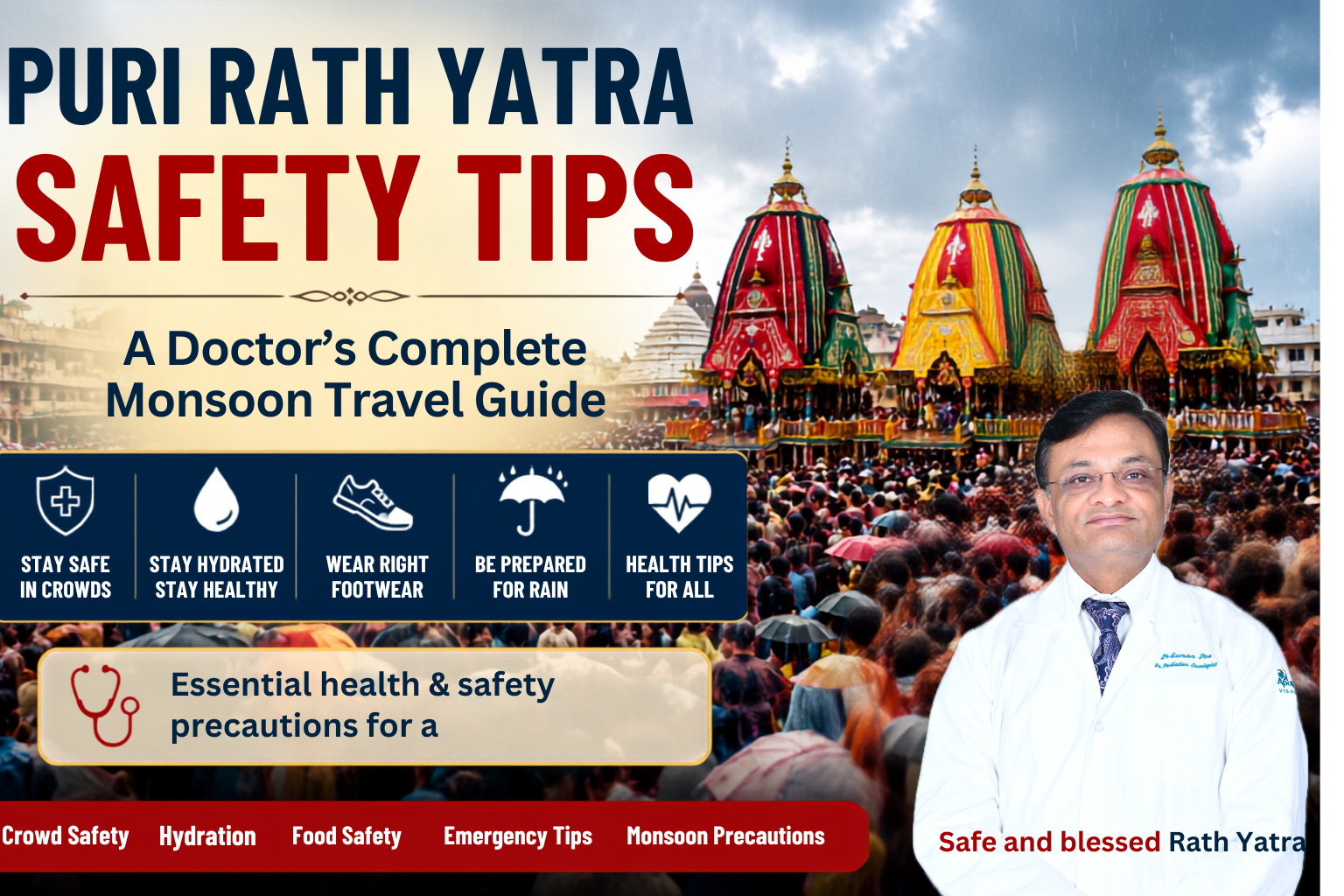
Crowds in the lakhs, non-stop rain, and zero shade, here is what every pilgrim, parent, and patient with a chronic illness needs to know before joining Rath Yatra this monsoon.
Rath Yatra is one of the most powerful experiences you will ever have but it is also physically demanding. A little preparation is the difference between a memory you treasure and an emergency you didn’t need to have.
Introduction
These Puri Rath Yatra safety tips could save you real trouble this monsoon. Every monsoon, lakhs of devotees make their way to Puri for Rath Yatra the pulling of Lord Jagannath’s chariot down the Grand Road (Bada Danda), one of the largest and most emotionally powerful public gatherings anywhere in India. As a physician, I see the aftermath of this festival every year in clinics and emergency rooms across Odisha: heat exhaustion, dehydration, falls on slick stone, children separated from families, and elderly relatives pushed well past what their bodies could safely handle.
None of this is inevitable. Rath Yatra during the monsoon is not like a normal festival outing. You have three things stacking up against you at the same time a crowd that can run into the millions, humidity that drains your energy far faster than you realise, and rain that turns the Grand Road into a slippery hazard within minutes. Stack all three together, and a small mistake the wrong footwear, an empty stomach, a missed meeting point can turn into a real medical emergency very quickly.
This guide walks through every precaution I would want my own patients and family to take, written specifically for families, elderly pilgrims, first-time visitors, parents travelling with children, and because this is the population I treat every day people managing diabetes, heart disease, hypertension, or recovering from cancer treatment.
Why Rath Yatra During Monsoon Needs Extra Preparation
Most pilgrims prepare for Rath Yatra the way they’d prepare for any temple visit — comfortable clothes, an umbrella, maybe a bottle of water. That preparation is built for a normal day, not for a monsoon crowd of this scale. The three stressors below rarely occur alone; during Rath Yatra they all hit at once, and each one makes the other two more dangerous.
Pilgrims typically gather along the Grand Road on peak days
Compounding risks: crowd density, humidity, and wet surfaces
Typical monsoon humidity in coastal Odisha — high even under cloud cover
How quickly heat exhaustion can set in inside a packed, humid crowd
Rain feels cooling, so people assume the heat risk is gone. It isn’t. Sweat that can’t evaporate because the air is already saturated with moisture is sweat that isn’t cooling your body — which is exactly why heat exhaustion catches so many pilgrims off guard during a “cool”, overcast Rath Yatra day.
What to Wear and the Footwear That Actually Matters
Clothing choices that work for an everyday errand can become genuinely dangerous in a crowd this dense. Two changes matter more than anything else.
Ditch the Umbrella
Skip the umbrella completely. In a crowd this packed, an open umbrella stops being protection and starts being a hazard — it pokes people, blocks sightlines, and you will almost certainly lose it the moment the crowd surges. A poncho or a lightweight raincoat does the same job without turning into a weapon in someone else’s face.
Best Footwear for Wet Stone and Tarmac
Wear closed, grippy sandals or shoes — never loose slippers, and never brand-new shoes you haven’t broken in. The stone and tarmac surfaces near the temple become dangerously slick once wet, and a fall in a moving crowd is far more serious than a fall on an empty street. If you’re travelling with women in the group, this is the moment to leave the heels and delicate footwear at the hotel, however good they’d look in photos — function has to win over fashion on the Grand Road.
| What to Wear | Why It Matters |
|---|---|
| Poncho or lightweight raincoat | Keeps hands free and doesn’t turn into a crowd hazard like an open umbrella |
| Closed, grippy sandals or shoes | Prevents slips on wet stone and tarmac near the temple |
| Quick-dry, breathable cotton clothing | Reduces heat rash risk from staying wet for hours in high humidity |
| Cross-body bag (not a loose handbag) | Keeps valuables secure and both hands free in a crowd crush |
| Cap or light scarf, not a large hat | Sun/rain cover that won’t get knocked off or block others’ view |
Hydration and Electrolytes: The Silent Monsoon Trap
Why “It’s Raining, I Don’t Need Water” Is Wrong
This is the trap I see people fall into every single year. It’s overcast, it’s raining, so the assumption is that the body doesn’t need water. It’s the opposite. Puri’s monsoon humidity is genuinely hard on your body even without direct sun you are sweating constantly, you simply don’t notice it because the rain is masking it. Dehydration in a humid crowd can sneak up on you with almost no warning signs until you’re already dizzy.
Electrolytes: Your Real Lifesaver
Carry a sealed water bottle and sip constantly don’t wait until you feel thirsty, because thirst is a lagging indicator, not an early one. Carry ORS or electrolyte sachets; in this specific combination of crowd density and humidity, they genuinely make the difference between someone who’s uncomfortable and someone who needs medical help. And eat something light before leaving your hotel. Never enter that crowd on an empty stomach low blood sugar plus heat plus standing for hours is a bad combination for anyone, and a dangerous one for diabetics.
Food Safety and Hygiene in the Crowd
Monsoon plus a massive crowd is a well-known recipe for stomach infections. Stick to hot, freshly cooked food and avoid pre-cut fruit or anything that’s been sitting out in the open food safety standards are harder to guarantee at a temporary festival stall than at a regular restaurant. Carry hand sanitizer, because you will be shaking hands, holding railings, and touching shared surfaces all day, often with no easy way to wash up. It’s also worth carrying basic medication for fever, stomach upset, and motion sickness if you’re travelling any distance by road.
Avoiding Crowd Crush: The Real Danger
This is the single most important section in this guide. In a crowd of this size, the greatest danger isn’t the rain it’s crowd crush. A handful of non-negotiable rules can meaningfully reduce that risk for you and your family.
Stay Away From the Ropes
Never stand at the edge where the chariot ropes are being pulled. That is where the majority of crowd-related injuries actually happen the pull-and-release motion of a rope under tension from thousands of hands is unpredictable.
Move With the Crowd
If you feel the crowd pushing in one direction, move with it, never against it. Fighting the flow of a dense crowd is how people fall, and a fall in a crowd crush is far more dangerous than the crush itself.
Keep Your Hands Free
Don’t try to hold a phone in one hand, prasad in the other, and a child at the same time. If you can’t keep at least one hand fully free, you can’t react if the crowd shifts suddenly.
Fix a Meeting Point On Paper
Agree on a fixed, physical landmark with your group before entering the crowd. Phone networks genuinely overload and crash during Rath Yatra. “I’ll just call you” is not a plan.
Keeping Children Safe in the Crowd
If you’re bringing young children, write your phone number on a slip of paper in their pocket or directly on their arm with a pen. It sounds excessive until you’ve actually seen how quickly a child can be separated from a parent in a crowd this size. Puri also has designated viewing areas and balconies that can be booked in advance specifically to avoid standing in the densest part of the crowd for hours. It costs a little more; it is worth every rupee for the safety margin alone.
Elderly Pilgrims: Special Precautions
If you’re travelling with elderly parents or relatives, please reconsider standing in the densest part of the crowd for hours at a stretch. Standing for long periods in heat and humidity is hard on the cardiovascular system even for healthy adults, and considerably more so for elderly pilgrims, many of whom are managing blood pressure or heart conditions already. Book a viewing balcony or seated area in advance rather than joining the crush at ground level it protects both their joints and their heart.
Advice for Women Travelling
Women travelling in groups should stick together, avoid the absolute peak crush hours where possible, and keep valuables in a cross-body bag rather than a loose handbag that can be snatched or dropped in a crowd surge. If you can, plan your position in the crowd with an exit route in mind rather than being boxed in on all sides.
Travelling With Chronic Diseases: Diabetes, Heart Disease, Hypertension and Cancer Survivors
This is the section I most want patients and families to read carefully, because most Rath Yatra safety advice online is written for healthy adults and doesn’t account for chronic illness at all. Standing for hours in heat, humidity, and physical crush is a real physiological stress test for the conditions below, a bit of extra planning goes a long way.
Diabetes
Never skip or delay meals to “save time” in the crowd. Carry glucose tablets or a small sugary snack, check blood sugar before you leave if you monitor regularly, and wear comfortable, well-fitted footwear even minor foot injuries take longer to heal and can go unnoticed in the excitement of the day.
Heart Disease
Avoid the densest crush entirely if you have known coronary artery disease or heart failure book a viewing spot instead. Carry your regular cardiac medication with you, not just at the hotel, and know the nearest medical booth location before you enter the crowd.
Hypertension
Heat, dehydration, and crowd stress can all raise blood pressure temporarily. Take your medication on schedule, hydrate steadily rather than in large gulps, and step out of the crowd at the first sign of a headache, flushing, or unusual breathlessness.
Cancer Survivors
If you’re on active treatment or recently completed it, immune function and heat tolerance can both be temporarily reduced. Prioritise a shaded viewing area over ground-level crowds, carry hand sanitizer diligently, and check with your treating oncologist before planning a trip during active chemotherapy or radiotherapy.
Recognising Heat Exhaustion — Even in the Rain
Standing for hours in wet clothes and high humidity causes heat rash and fatigue faster than dry, sunny heat does, because sweat isn’t evaporating properly off your skin. Carry a small towel to dry off periodically, and if you’re prone to skin issues, a little antifungal powder in your bag helps more than most people expect. If anyone in your group feels dizzy, nauseous, or unusually tired, don’t push through it for the sake of “darshan hobe” step out of the crowd immediately, hydrate, and rest in shade or a nearby shop. Heat exhaustion inside a packed crowd is genuinely dangerous, precisely because it’s hard to get someone out quickly once they’re unwell.
| Symptom | What to Do |
|---|---|
| Dizziness or lightheadedness | Step out of the crowd immediately, sit down, sip ORS/water slowly |
| Nausea or vomiting | Move to shade, loosen clothing, stop food/water briefly, seek medical booth if it persists |
| Cold, clammy skin despite heat | This is a warning sign, not a good one — get medical help promptly |
| Rapid heartbeat or breathlessness | Rest immediately; treat as urgent in anyone with heart disease or hypertension |
| Confusion or unusual behaviour | Treat as a medical emergency — get to the nearest medical or police booth right away |
Emergency Planning: The One Precaution That Actually Saves Lives
Save the Puri Rath Yatra control room helpline and the local police helpline in your phone before you leave home not when you need them. Note down your hotel’s exact address and a nearby landmark, because “that hotel near the temple” means nothing when you’re trying to get help in a crowd of a million people. If you get separated from your group, don’t wander around looking for them. Go straight to the nearest police booth or announcement point they exist specifically for this.
| Save Before You Leave | Why |
|---|---|
| Puri Rath Yatra control room / helpline number | Direct line for crowd-related emergencies during the festival |
| Local Puri police helpline | Fastest route to help if someone is separated or injured |
| Hotel’s exact address + nearby landmark | Vague descriptions don’t work when networks are overloaded |
| Nearest hospital / medical booth location | Critical for chronic disease patients and elderly travellers |
| Fixed physical meeting point for your group | Phone networks routinely overload during peak Rath Yatra hours |
Useful Packing Checklist for a Safer Rath Yatra
- Poncho or lightweight raincoat (not an umbrella)
- Closed, grippy, well broken-in footwear
- Sealed water bottle and ORS/electrolyte sachets
- Light snack or glucose tablets, especially for diabetics
- Regular medication for chronic conditions, carried on your person
- Small towel and antifungal powder
- Hand sanitizer and basic first-aid/motion sickness medication
- Cross-body bag for valuables, hands kept free
- Written emergency numbers and hotel address, even if you also save them digitally
- Slip of paper with contact number in each child’s pocket
Frequently Asked Questions About Puri Rath Yatra Safety Tips
Is Puri Rath Yatra safe during monsoon?
Yes, for the vast majority of pilgrims but it demands more preparation than a typical temple visit. The combination of crowd density, humidity, and wet surfaces raises the risk of dehydration, falls, and crowd-crush injuries, all of which are largely preventable with the precautions in this guide.
Should elderly parents attend the main crowd on Grand Road?
Where possible, book a designated viewing balcony instead of standing in the ground-level crush for hours. It gives the same darshan experience with far less cardiovascular and fall risk.
What should diabetics carry specifically for Rath Yatra?
Glucose tablets or a small sugary snack, your regular medication, and a habit of eating on schedule rather than skipping meals to “not miss” any part of the procession.
Is bottled water enough, or do I need ORS?
Plain water alone doesn’t replace the salts lost through hours of sweating in humid conditions. ORS or an electrolyte sachet mixed into your water is genuinely worth carrying, not just a precaution for extreme heat.
What is the single most important safety tip?
Save the Puri Rath Yatra helpline and local police number in your phone before you leave home, and fix a physical meeting point with your group — phone networks frequently overload during the festival.
A Doctor’s Final Advice
Conclusion
Rath Yatra is genuinely one of the most powerful experiences you will ever have the energy, the devotion, all of it is real, and no safety checklist can (or should) diminish that. But it is also physically demanding, and a little preparation is the difference between an experience you’ll treasure and one that goes wrong in ways it didn’t need to. Share this with anyone in your family planning to go this year, especially if they’re travelling with children, elderly relatives, or managing a chronic illness. Jai Jagannath, and stay safe out there. These Puri Rath Yatra safety tips are worth reading twice before you pack your bags.


1 Comment
Chandana Das
July 15, 2026Thank you so much for sharing such valuable information. Every year accidents happens during Rath yatra because of some negligence & over confidence. So we should follow these instructions to avoid such accidents.